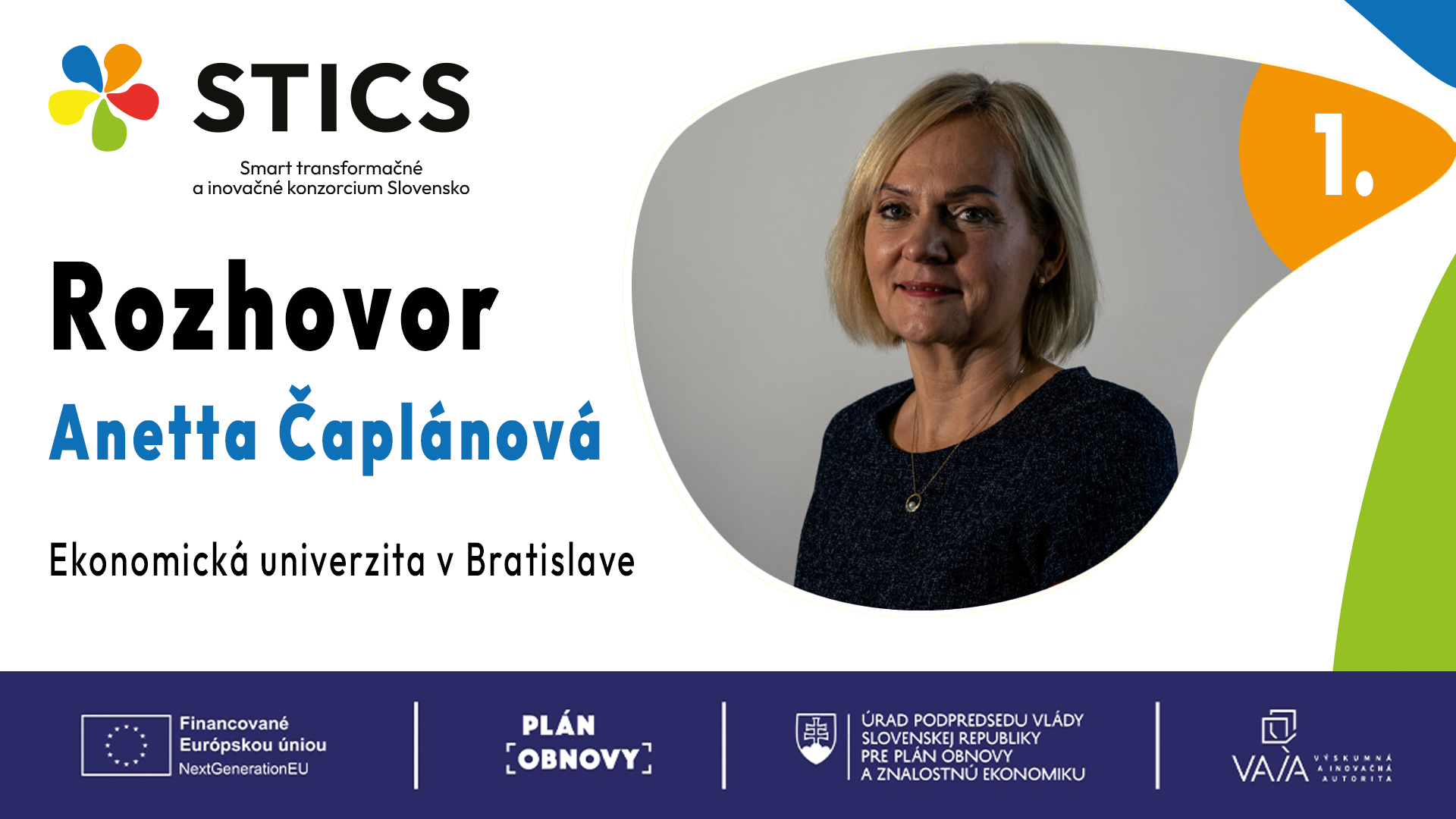
Anetta Čaplánová is a manager and researcher at the University of Economics in Bratislava.
What is your role in the consortium, and what does your organisation specifically bring to the STICS project?
The University of Economics in Bratislava acts within the STICS consortium as an academic and analytical partner connecting economic research, public policy, and the practical needs of regional and local government. We bring expertise in digital and sustainable transformation, behavioural economics, public economics, policy evaluation, and data analysis. Our role is to contribute to the creation of evidence-based solutions that help us better understand the needs of local governments, residents, businesses, and other actors involved in the innovation ecosystem. EUBA also strengthens the project methodologically through econometric analysis, surveys, stakeholder mapping, impact assessment, and the formulation of public policy recommendations. Our organisation’s specific contribution lies in its ability to turn the project’s technical and data-driven solutions into understandable, usable, and policy-relevant outputs that support Slovakia’s smart, inclusive, and sustainable transformation.
What have you managed to implement, develop or organise by roughly the midpoint of the STICS project – and what are you most proud of?
By the midpoint of the project, EUBA had been actively involved in STICS’s expert and methodological work, particularly within WP2, where it contributed behavioural studies to improve understanding of the decision-making, motivations, and barriers of relevant actors when introducing smart and sustainable solutions. These outputs help connect the project’s technological and data-driven solutions with the real behaviour of residents, local governments, businesses, and other stakeholders, which is crucial for their practical applicability. Another important result is our role as the leader of WP6, within which we coordinate living labs as spaces for testing, validating, and co-creating solutions in cooperation with partners and users in real-world settings. In this way, we have managed to strengthen the links between academic research, public administration, businesses, and regional actors, and to create a foundation for solutions that are not developed in isolation “at a desk”, but in direct contact with the real needs of territories. We are most proud that we are succeeding in moving the project from analytical preparation towards practically testable, evidence-based, and usable solutions supporting Slovakia’s smart, inclusive, and sustainable transformation.
What do you plan to complete and deliver by the end of the project?
By the end of the project, we plan to focus EUBA’s main efforts on the development, coordination, and evaluation of living labs as a practical environment in which STICS solutions will be tested, validated, and co-created in cooperation with partners, local governments, businesses, users, and other regional actors. We want to closely connect the outputs of the living labs with the findings from WP2, especially behavioural studies focused on decision-making, motivations, barriers, and the adoption of smart and sustainable solutions in practice. Our goal is for the living labs to produce not only formal project activities, but also concrete knowledge about which solutions are genuinely usable, acceptable, and scalable for individual territories. At the same time, we plan to contribute to the outputs of other work packages by translating the knowledge gained into analytical, methodological, and policy-relevant inputs supporting the achievement of the project’s planned milestones and deliverables. By the end of STICS, we want to deliver outputs that are academically robust, practically validated, and usable for the further development of data-driven, smart, and sustainable transformation in Slovakia.
How will these outputs affect the target group, and what innovation do they bring?
EUBA’s outputs will influence the target groups primarily by actively involving them in testing and co-creating STICS solutions through living labs, rather than making them merely passive recipients of finished technological solutions. They will give local governments, regional actors, businesses, and users a better understanding of needs, barriers to adoption, and the practical conditions under which smart and sustainable solutions can actually work. Behavioural studies and findings from WP2 will help explain why some solutions are readily accepted in practice while others encounter distrust, low motivation, or organisational obstacles. The innovation lies in combining the living-lab approach, behavioural insights, data-driven analysis, and feedback from actors directly within the territory. As a result, the project outputs will be more practical, better targeted, and more useful in the design of policies, services, and solutions supporting Slovakia’s smart, inclusive, and sustainable transformation.
What has the STICS project brought to your organisation – and to you personally?
The STICS project has significantly strengthened EUBA’s role as an academic partner capable of connecting research, public policy, regional development, and practical innovation solutions. For our organisation, it is particularly important that we can participate directly in the development of living labs, behavioural studies, and policy-relevant outputs with the potential to extend beyond the scope of the project itself. STICS has also created space for more intensive cooperation with local governments, businesses, research organisations, and other actors shaping Slovakia’s smart and sustainable transformation. Personally, I see the project as an opportunity to bring economic and behavioural research closer to real decisions, territorial needs, and specific public policies. For me, the greatest value lies in the opportunity to co-create solutions that are not only academically interesting, but also have practical significance for people, institutions, and regions.
What experience have you gained in the project? What would be worth developing further, and what would you do differently next time?
The STICS project has given us valuable experience in connecting academic research, behavioural insights, technological solutions, and the practical needs of local governments, businesses, and regional actors. It has shown that the greatest value is created when solutions are not developed in isolation, but in open dialogue with users and partners through living labs. In the next phase, it would be useful to further develop the systematic evaluation of feedback from living labs, shared methodological tools, impact measurement, and knowledge transfer between individual work packages. We also see significant potential in further linking the behavioural studies from WP2 with practical solution testing and the formulation of public policy recommendations. Next time, we would establish a shared methodological framework, an output schedule, and communication channels between partners even earlier, so that knowledge from research, fieldwork, and implementation could be connected more quickly and effectively.
In your view, what is the greatest added value of the STICS project?
The greatest added value of the STICS project is its ability to connect research, technology, public administration, businesses, and regional actors within a single functional innovation ecosystem. The project does not view smart and sustainable transformation merely as a technical challenge, but as a process that must be based on the real needs of territories, users, and institutions. The living-lab approach is particularly important because it allows solutions not only to be designed, but also tested, validated, and co-created directly with the target groups. Another added value of STICS is that it combines data-driven solutions with behavioural insights and practical feedback, increasing the likelihood that the project’s results will actually be accepted and used. The project thus creates a foundation for a smarter, more inclusive, and more sustainable transformation of Slovakia, based not only on technology but also on cooperation, trust, and the ability to turn knowledge into practice.
What should remain and keep working even after the project ends?
After the project ends, above all, the living labs should continue to operate as open spaces for further testing, validating, and co-creating smart and sustainable solutions in cooperation with local governments, businesses, research organisations, and users. It is also important to preserve the methodological tools, behavioural insights, and feedback mechanisms that make it possible to better understand territorial needs and translate them into specific policies, services, and innovations. Cooperation between the partners should continue after the project as well, because the connection between academic research, data-driven solutions, public administration, and practice is one of STICS’s greatest strengths. We also consider it essential for the project’s results to remain usable for future decision-making, strategic planning, and the development of data-driven innovation ecosystems in Slovakia. Ideally, STICS should not end as a one-off project, but become the foundation of a long-term platform for the smart, inclusive, and sustainable transformation of territories.