
COMENIUS UNIVERSITY BRATISLAVA
ABOUT US
Comenius University Bratislava is a modern European university. It is the only Slovak higher education institution that regularly appears in global rankings of the world's best universities. Across 13 faculties it offers the widest range of study programmes in the country (currently 731) at all three levels, several of which are unique in Slovakia. Students can choose from a broad spectrum of fields, from medicine through the humanities and social sciences, natural sciences and mathematics to theology. Comenius University is a research institution running hundreds of Slovak and international research projects.
Our website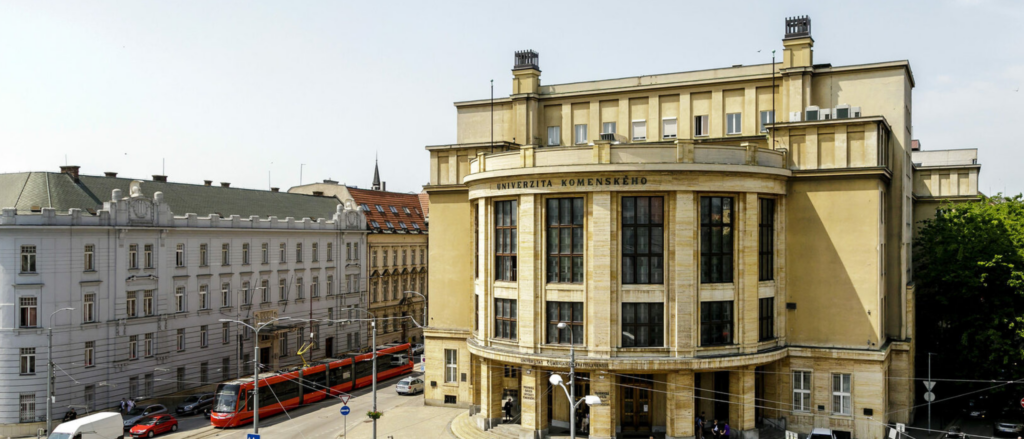
OUR ACTIVITIES WITHIN THE CONSORTIUM
Comenius University, specifically the Faculty of Management, contributes to WP1, WP2, WP5 (T5.2 – task leader), WP6 (T6.5), WP7 (T7.1) and WP8 (T8.4 – task leader).
BENEFITS OF OUR OUTPUTS AND TARGET GROUPS
We see our team's contribution as carrying out tasks and research in areas that map the effectiveness, efficiency and transparency with which municipalities use publicly available funding to invest in smart solutions that are economically sustainable, environmentally sound and responsive to social challenges. Further contributions will include innovative business models and investment approaches to the tasks at hand. Because municipalities are often unable to formulate effective innovation projects, combine different funding sources or engage in their own business activities due to complex legislation, we want to identify funding options aligned with long-term development strategies and procure innovative solutions on the market. The target group will mainly be municipalities and their management, but also academia and educational organisations.
Our results will support the development of strong, innovation-oriented regional economies, the completion of infrastructure for an innovation-oriented green economy, improved sustainability and resilience of regional economies, better accessibility, transparency and efficiency of public administration, and stronger economic sustainability for municipalities, towns and regions.

Peter Štarchoň
team leader, responsible for the overall coordination of tasks and activities
What do you expect from the STICS project?
From the STICS project we expect an integrated cooperation programme delivering the development and transfer of innovation that supports smart and green transformation processes in the public sector. Living Labs have the potential to launch and sustain long-term transformation processes in urban and regional communities and their economies, which require continuous demand for innovation, drive research and development activity, and enable the rapid transfer of innovation into practice. The Living Labs will create a platform for cooperation within the consortium and for participatory processes even after the project ends. A special position among the Living Labs will belong to the pilot Smart Green Campus, built on past joint activities of STU and Comenius University. It provides space to host the consortium's joint research and development activities, a technology incubator, startups, spin-offs and scale-ups, and serves as a permanent interface between the partners of the quadruple helix: research and development, business partners, representatives of the public sector and local government, and the third sector.
Who will be able to use your outputs, and when?
Part of the results, those supporting the development of strong, innovation-oriented regional economies, the completion of infrastructure for an innovation-oriented green economy, improved sustainability and resilience of regional economies, better accessibility, transparency and efficiency of public administration, and stronger economic sustainability for municipalities, towns and regions, is intended primarily for municipalities and regions. Another part is applicable and usable in academia or business. The transfer of some innovations into practice can be observed in the short term, while other results will take a medium-term horizon.