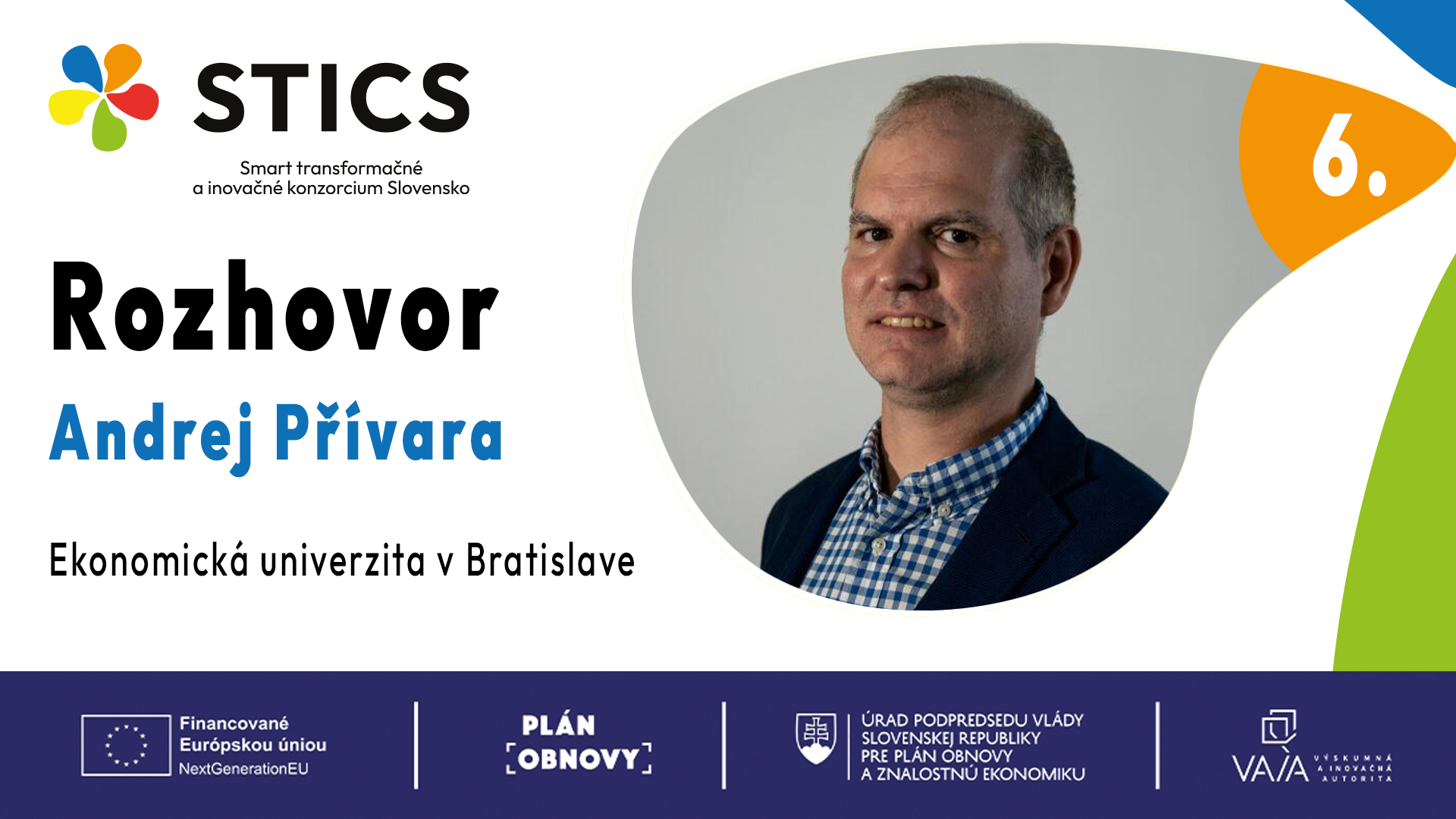
Ing. Andrej Přívara, PhD. works at the University of Economics in Bratislava as the STICS Project Quality Manager.
What is your role in the consortium, and what does your organisation specifically bring to the STICS project?
In the consortium, I serve as the STICS project quality manager, that is, the project’s quality manager. I am responsible for setting up and maintaining the quality assurance system for project outputs: formal checks of deliverables before submission (the QG-2 process), uniform rules for document naming, versioning, and language versions, maintenance of the QA register, and preparation of outputs for final approval and archiving.
The University of Economics in Bratislava is also responsible for deliverable D1.3, the Quality Plan, which provides the methodological framework for quality control across the entire consortium and defines the criteria every project output must pass. EUBA also contributes expert capacity in economics and public policy, contributed to deliverable D8.4, and the project includes doctoral dissertations focused on behavioural economics in public administration and electronic services.
What have you managed to implement, develop or organise by roughly the midpoint of the STICS project – and what are you most proud of?
I consider the main result of the first half of the project to be the establishment of a functioning quality assurance system based on deliverable D1.3, the Quality Plan. This was not merely about producing a document: in practice, uniform rules were introduced for preparing project outputs, their naming, versioning, and language versions, together with a multi-stage review process and records in the QA register, which makes it possible at any time to demonstrate the status of each output.
The benefit became clear during preparation of the first monitoring report, when more than twenty outputs from different partners had to be compiled in two language versions within a short period of time. Thanks to the established rules and register, it was possible to quickly verify their status, identify missing materials, and prepare a consistent package of annexes.
What pleases me most is that, in a consortium of 24 partners, we have managed to make quality control a normal part of preparing outputs rather than a formality at the end of the process.
What do you plan to complete and deliver by the end of the project?
By the end of the project, I will continue to ensure quality control of all remaining project outputs, starting with the package of outputs planned for September 2026 within WP3 and WP7. This includes completing the formal closure of outputs already delivered, namely adding approval records and an audit trail so that the project documentation is ready for inspection or audit at any time.
The Quality Plan will be updated in the second phase of the project based on the experience gained so far during implementation. I also expect to remain involved in preparing further monitoring reports and in the consortium’s publication outputs.
How will these outputs affect the target group, and what innovation do they bring?
Quality control is not the most visible part of the project externally, but it is precisely what determines whether research results reach the target groups in a usable form. Cities, municipalities, and regions will receive methodologies and tools that have passed a verified review process, are traceable, version-controlled, and available in both language versions. This reduces the risk that a local authority will work with an outdated or unapproved document.
An innovative element is the design of the quality system itself within a consortium of 24 partners from the academic, public, and business sectors, where each organisation has its own practices. Creating a common framework with uniform rules and multi-stage review can also be transferred to other projects of a similar scale.
What has the STICS project brought to your organisation – and to you personally?
For EUBA, the project has brought participation in a broad consortium connecting the academic sector with local governments and companies. This has created space for research focused on the real needs of cities and municipalities, for publication outputs, and for topics of final and doctoral theses that arise directly from project activities.
Personally, the role of quality manager has given me a different perspective on project management. The quality of an output depends not only on the professional standard of the text, but equally on whether it is possible to trace who approved it, when, and in which version. I have also learned to work with a very diverse group of partners and to look for solutions that are formally correct while still manageable in practice.
What experience have you gained in the project? What would be worth developing further, and what would you do differently next time?
The most valuable lesson is that a quality system cannot be introduced simply by issuing a document. What matters is that partners understand what the rules are for and have enough time to comply with them.
It would be useful to further develop the continuity of the process. It works well when an output reaches quality control sufficiently in advance rather than immediately before the submission deadline, when there is no longer room to incorporate comments.
Next time, from the very beginning I would define the quality-control timetable more precisely, including specific dates for submitting materials to the QA officer linked to output deadlines, together with the approval and archiving procedure.
In your view, what is the greatest added value of the STICS project?
The greatest added value is connecting worlds that usually operate separately in our country. The academic sector has research capacity, local governments understand the real problems of their territories, and companies can provide technology. STICS has brought these three sides to one table and created a space where solutions are not only designed but also tested in specific cities and municipalities through living labs.
Equally important is that the project does not stop at theoretical concepts. Its outputs take the form of usable tools, methodologies, and training programmes that local governments can implement in their own practice.
What should remain and keep working even after the project ends?
First and foremost, the networks and relationships between partners should remain. The cooperation established during the project between universities, local governments, and companies will retain its value after the project ends and should continue through further projects and joint activities.
Living labs should also remain as environments in which innovation can be tested under real-world conditions, along with the training programmes prepared within WP7, which can become part of a permanent lifelong-learning offer for local-government employees.
I also consider the project’s methodological foundation, including the quality assurance system, to be a lasting contribution. It is a transferable framework that can be used in managing other large-scale consortium projects, not only at EUBA.